Crawl Space Moisture Making Flooring Fail

Crawl space moisture warps floors through trapped vapor that swells wood planks, causing cupping, buckling, and soft spots. Standing water also invites mold and weakens framing. Vital Flooring & Crawlspaces fixes this with crawlspace encapsulation, sealing the space to block moisture at its source. Licensed contractors restore floors and protect the home’s structure.
How does crawl space moisture ruin your floors?
Crawl space moisture destroys flooring through multiple mechanisms that operate simultaneously. Moisture making flooring fail begins when water vapor rises from the soil beneath a home and becomes trapped in the subfloor cavity. This trapped humidity attacks flooring materials from below, where damage remains invisible until the surface shows irreversible signs of failure.
Crawl space moisture flooring damage ranks among the leading causes of structural deterioration in North Carolina homes. The state's humid climate makes the problem nearly universal for properties with vented crawl spaces. Standing water and excess moisture invite mold, weaken wood framing, and lead to hefty repair bills. The damage accelerates quickly once moisture levels cross a critical threshold.
What causes hardwood floor cupping from crawl space moisture?
Hardwood floor cupping crawl space problems develop when the underside of floorboards absorbs more moisture than the top surface. The saturated bottom edge swells, forcing board edges to curl upward while the center dips. This creates a washboard effect across the entire floor. Cupping signals that subfloor moisture has already compromised the wood's structural integrity.
Buckling floors moisture damage represents the most severe stage of crawl space related floor failure. Floorboards actually lift off the subfloor as expanding wood pushes against adjacent boards. The floor becomes uneven, squeaks underfoot, and eventually separates at the seams. At this point, replacement is often the only option.
How does subfloor moisture damage spread to floor joists?
Subfloor moisture damage migrates downward into the structural framing. Plywood subflooring delaminates when saturated, losing its ability to hold fasteners. Floor joist rot crawl space conditions develop as fungal growth consumes the cellulose in wooden joists. This rot weakens the entire floor system. Crawl space moisture also ranks as a leading cause of pest infestations in NC homes, since termites and wood-destroying insects thrive in damp environments.
Vital Flooring & Crawlspaces addresses these problems through comprehensive crawl space encapsulation Wake Forest NC services. The company installs a crawl space vapor barrier Raleigh NC system that blocks ground moisture before it reaches flooring materials. This licensed and insured contractor serves homeowners across Wake Forest, Raleigh, and the surrounding Triangle area with flooring solutions and crawlspace services that stop moisture damage at its source.

What are the signs of moisture making flooring fail?
Moisture making flooring fail announces itself through unmistakable warning signs. Homeowners who ignore these indicators risk structural damage that compounds in cost and severity. Musty odors often appear first, signaling hidden dampness beneath the floor surface. Buckling floors follow as wood absorbs excess moisture and warps against its fasteners. Visible mold or fungus growth on baseboards or flooring edges confirms a persistent moisture problem. Elevated indoor humidity throughout the home points directly to crawl space conditions affecting living spaces above. Wood rot in subflooring or joists represents the most advanced stage of moisture damage.
What does hardwood floor cupping from crawl space moisture look like?
Hardwood floor cupping crawl space damage creates a distinctive washboard appearance across affected rooms. Individual planks develop raised edges while centers sink downward, forming a concave shape. This cupping pattern occurs because the underside of each board absorbs more moisture than the exposed top surface. The condition worsens seasonally as crawl space humidity fluctuates with North Carolina weather patterns.
How does buckling floors moisture damage progress?
Buckling floors moisture damage begins subtly before becoming impossible to ignore. Floorboards first develop slight peaks at seams where expansion forces planks together. The buckling intensifies until boards pull completely free of the subfloor in severe cases. Subfloor moisture damage accelerates this process by weakening the structural layer beneath finished flooring. Floor joist rot crawl space conditions develop when moisture attacks the framing members supporting the entire floor system. This rot compromises load-bearing capacity and requires immediate professional intervention.
Vital Flooring & Crawlspaces identifies these signs during comprehensive inspections across Wake Forest and Raleigh homes. The company's licensed contractors trace visible flooring damage back to its crawl space source. Crawl space water usually originates from plumbing leaks, poor drainage, groundwater seepage, or condensation. It accumulates before homeowners notice any change in living areas. Crawl space encapsulation Wake Forest NC services address these moisture sources permanently. A properly installed crawl space vapor barrier Raleigh NC system prevents moisture migration into flooring materials above.
How do you fix crawl space moisture flooring damage?
Fixing crawl space moisture flooring damage requires a systematic approach. The process starts with identifying the water source and then repairing both the crawl space environment and the damaged flooring above. Delaying action invites mold growth, wood rot, and escalating repair costs. The quicker a repair begins, the more likely the issue resolves without long-term structural harm.
What causes moisture damage to floors above a crawl space?
Crawl space moisture flooring damage develops when excess humidity or standing water beneath a home migrates upward. This moisture saturates the subfloor moisture damage layer and the flooring material itself. Hardwood absorbs the vapor and expands, leading to hardwood floor cupping crawl space conditions where board edges curl upward. Buckling floors moisture problems occur when planks actually lift from the subfloor. Moisture making flooring fail also attacks adhesives, breaks down engineered cores, and invites floor joist rot crawl space deterioration that compromises structural integrity.
How do professionals repair moisture-damaged floors?
Repair follows a clear sequence. First, the source of water intrusion must be eliminated. Addressing the problem starts with identifying the source of the water and understanding how it affects the home. This Old House experts note that crawl spaces sit below grade, making them vulnerable to soil moisture, poor drainage, and plumbing leaks.
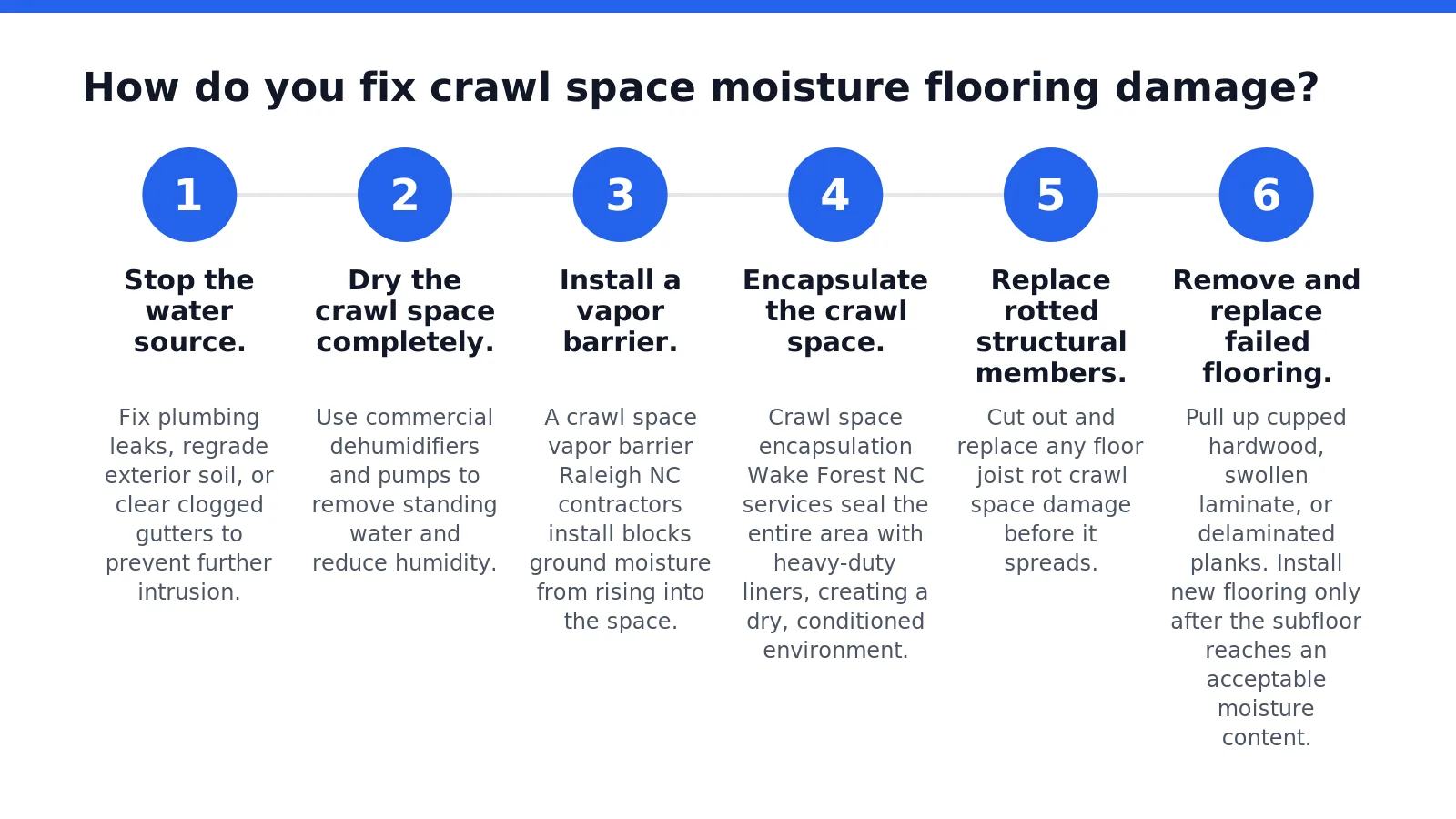
The repair process proceeds through these steps:
- Stop the water source. Fix plumbing leaks, regrade exterior soil, or clear clogged gutters to prevent further intrusion.
- Dry the crawl space completely. Use commercial dehumidifiers and pumps to remove standing water and reduce humidity.
- Install a vapor barrier. A crawl space vapor barrier Raleigh NC contractors install blocks ground moisture from rising into the space.
- Encapsulate the crawl space. Crawl space encapsulation Wake Forest NC services seal the entire area with heavy-duty liners, creating a dry, conditioned environment.
- Replace rotted structural members. Cut out and replace any floor joist rot crawl space damage before it spreads.
- Remove and replace failed flooring. Pull up cupped hardwood, swollen laminate, or delaminated planks. Install new flooring only after the subfloor reaches an acceptable moisture content.
Can cupped hardwood floors be saved?
Cupping sometimes reverses if caught early and the moisture source is eliminated. Mild cupping may flatten as the wood dries over several weeks. Severe cupping or boards that have started buckling require replacement. Sanding a cupped floor before it fully dries creates permanent damage by removing the raised edges while the center remains swollen. Vital Flooring & Crawlspaces' licensed and insured contractors assess the extent of the damage and determine whether refinishing or full replacement delivers the best outcome. The company's expertise in both crawlspace remediation and flooring installation ensures the underlying cause is resolved before new materials go down.
What is crawl space encapsulation and why does it matter?
Crawl space encapsulation seals the under-home area against ground moisture and outside air. Vital Flooring & Crawlspaces installs a heavy-duty vapor barrier across the floor and foundation walls, creating a dry, controlled environment beneath the living space. Without this barrier, humidity rises from exposed soil and condenses on floor joists and subflooring. That persistent dampness triggers crawl space moisture flooring damage that homeowners often miss until floors begin to fail.
The process transforms a damp, dirt-floor crawl space into a clean, conditioned zone. Moisture making flooring fail is a direct consequence of unsealed crawl spaces. Warm, humid air enters through foundation vents and meets cooler surfaces below the house. Condensation forms. Wood absorbs the water. Over weeks and months, subfloor moisture damage weakens the structural layer directly beneath the flooring. Homeowners in Wake Forest and Raleigh face this risk year-round because of North Carolina's humid climate.
How does encapsulation prevent hardwood floor cupping?
Hardwood floor cupping crawl space problems start when the underside of floorboards absorbs more moisture than the top surface. The edges swell and curl upward. Encapsulation stops this by eliminating the moisture source. A properly installed vapor barrier keeps relative humidity below the subfloor consistently low. The wood remains dimensionally stable. Floors stay flat.
Why do floors buckle over unsealed crawl spaces?
Buckling floors moisture damage occurs when wood planks expand so much they push against each other and lift off the subfloor. This happens rapidly during seasonal humidity spikes. Encapsulation removes the humidity driver entirely. The crawl space stays dry. Flooring stays intact.
Crawl space encapsulation Wake Forest NC services from Vital Flooring & Crawlspaces include sealing vents, installing a crawl space vapor barrier Raleigh NC homeowners can rely on, and adding a dehumidifier when needed. The company's licensed contractors inspect for existing floor joist rot crawl space damage before beginning any encapsulation work. Rotted joists compromise the entire floor system. Catching that damage early prevents structural failure and costly floor replacement.
This veteran-owned, family-operated business delivers encapsulation as a permanent moisture solution, not a temporary fix. Homeowners who delay encapsulation risk losing thousands of dollars in ruined hardwood, tile, and luxury vinyl plank flooring. The company's straightforward pricing and local expertise make it a trusted alternative to large national chains. Every encapsulation project starts with a thorough crawl space assessment. The team identifies moisture sources, measures humidity levels, and builds a custom plan that protects both the subfloor and the finished flooring above.
How do you prevent future floor damage from crawl space moisture?
Preventing future floor damage starts with early detection and professional intervention. Catching moisture problems early makes the fix far less complicated and less costly. Homeowners who delay repairs risk moisture making flooring fail through warping, cupping, and structural weakening.
What causes crawl space moisture flooring damage?
Standing water and excess humidity beneath a home create conditions that destroy flooring from below. Hardwood floor cupping crawl space problems develop when moisture rises through the subfloor and saturates wood fibers. Buckling floors moisture signals advanced deterioration that demands immediate attention.
Follow these steps to protect floors permanently:
- Inspect the crawl space regularly for standing water, condensation, or damp soil.
- Address drainage issues by grading soil away from the foundation and extending downspouts.
- Install a crawl space vapor barrier to block ground moisture from reaching subfloor moisture damage zones.
- Encapsulate the crawl space to seal out humidity and prevent floor joist rot crawl space conditions.
- Schedule professional evaluation with Vital Flooring & Crawlspaces for crawl space encapsulation Wake Forest NC solutions.
Does crawl space vapor barrier Raleigh NC installation stop recurring damage?
A properly installed vapor barrier interrupts the moisture cycle that feeds floor deterioration. Vital Flooring & Crawlspaces serves Wake Forest, Raleigh, and the Triangle as the trusted local alternative to big-box flooring companies. The company's commitment to customer satisfaction enhances the look and longevity of floors across the region.
Conclusion
Crawl space moisture ruins floors from below, but encapsulation stops the cycle at its source. Homeowners who act before cupping or buckling sets in protect both their subfloor and finished flooring from costly replacement. The decision to seal the crawl space transforms a hidden vulnerability into a permanent defense, keeping floors flat and structurally sound for years.